




Knee pain can become part of your routine before you realize how much you are working around it. You take the stairs differently, avoid longer walks, or think twice before getting up from a low chair. Rest may help temporarily, only for the discomfort to return once you become active again.
When knee pain has lasted for weeks or months, the next step does not always have to involve an injection or surgery. Depending on what is causing your symptoms, non-invasive treatments may still be worth exploring. StemWave therapy is one option used to support circulation and the body’s natural healing response in areas affected by chronic pain or overuse.
When Knee Discomfort Keeps Coming Back

Chronic knee pain can develop gradually rather than following one obvious injury. Repetitive strain, tendon irritation, and osteoarthritis can all contribute to discomfort that continues for weeks or months. Symptoms may improve temporarily with rest, only to return when you become more active.
You may notice stiffness when you first get moving, swelling that comes and goes, or pain after walking and climbing stairs. Some people find themselves changing how they move without realizing it. They may avoid certain activities or put more weight on the other leg.
Those patterns can have different underlying causes, and that matters when choosing treatment. Tendons, cartilage, and other structures around the joint may be involved. Understanding your particular case of knee pain can help determine which treatment options are appropriate and whether a non-invasive approach may be worth considering.
What Non-Invasive Knee Pain Treatment Usually Involves First
Most conservative care for chronic knee pain starts with rest, activity modification, physical therapy, and anti-inflammatory medication. For some patients, this combination is enough. For others, progress stalls after a few weeks, and the pain settles into a pattern that does not respond to the same treatment.
- Physical therapy focused on strengthening the muscles supporting the knee
- Activity modification to reduce repetitive loading on the joint
- Anti-inflammatory medication for short-term symptom control
- Bracing or sports kinesio taping to support the knee during movement and activity
When this stage does not bring lasting relief, the usual next recommendation is a corticosteroid injection or, in more advanced cases, surgery. Shockwave therapy is often introduced around this point, as an option to try before moving to something more invasive.
Why Therapy May Help with Chronic Pain
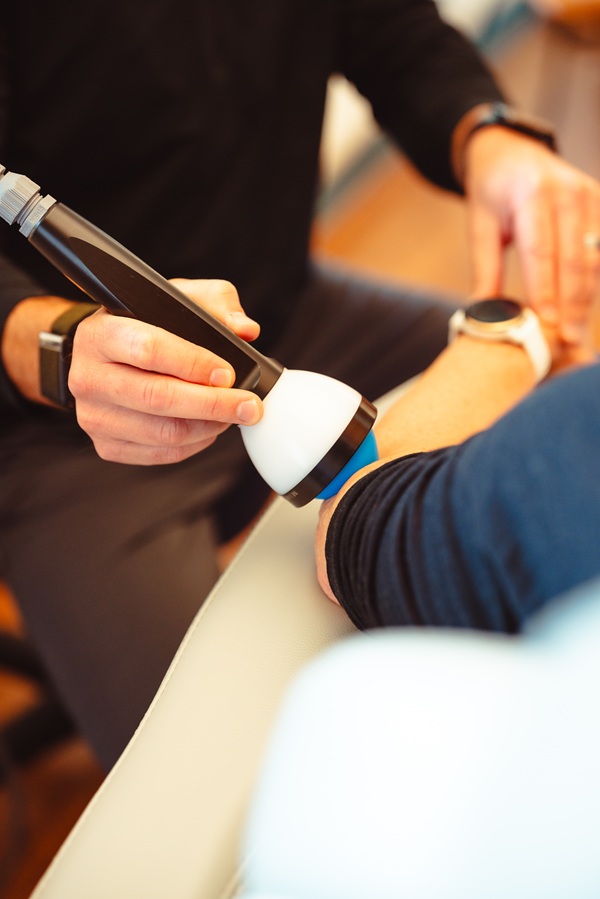
Chronic knee pain can involve tissues that have remained irritated despite rest or changes in activity. Acoustic wave therapy delivers pulses through the skin to the affected area. These pulses can increase local circulation and stimulate cellular activity involved in tissue repair and remodeling.
There may also be an effect on how pain signals are transmitted. Research suggests shockwave therapy may affect the unmyelinated sensory fibers involved in carrying pain signals. This may help explain why changes in discomfort can occur before longer-term tissue changes are complete.
For chronic knee pain, these effects can make acoustic wave therapy worth considering alongside other conservative treatments. The goal is to support the tissue and improve function without immediately moving to a more invasive option.
Research on Shockwave Therapy for Chronic Knee Discomfort
Research on shockwave therapy has shown promising results for certain types of chronic knee pain. One systematic review covering 14 studies and 782 participants found that shockwave therapy improved pain and function in people with mild to moderate knee osteoarthritis. Benefits were measured for up to 12 weeks.
Other research comparing two types of shockwave therapy found reductions in pain scores, along with improvements in walking distance and knee function.
These findings do not mean StemWave therapy is appropriate for every painful knee. Much of the research focuses on mild to moderate osteoarthritis and chronic musculoskeletal conditions. The cause and severity of your knee pain still matter when deciding whether this type of treatment makes sense.
Who May Benefit From Non-Invasive Pain Treatment
You may be a reasonable candidate for shockwave therapy if your knee pain has persisted for several months, has not fully resolved with rest and physical therapy, and involves tendon irritation or early to moderate arthritic changes rather than a structural tear needing repair. It can also be relevant for former athletes or active adults managing pain from old injuries that never fully settled.
Chronic pain that developed after old surgeries, like a prior ACL repair, sometimes falls into this category as well, particularly when the surgical site has fully healed, but the surrounding tissue never regained its previous strength or comfort.
What a Treatment Plan Might Look Like
A typical course involves several sessions spaced apart, though the exact schedule depends on how you respond. Each session usually takes 10 to 20 minutes, with a handheld applicator delivering pulses directly to the treatment area through a conductive gel.
- An initial evaluation to confirm the pain source and rule out cases that need a different approach
- A series of sessions spaced over several weeks
- Reassessment along the way to track pain and function changes
- Adjustments to the plan if progress is slower than expected
Some patients notice improvement within the first few sessions. For others, especially those with longer-standing pain, changes build more gradually as the tissue responds over the full course of treatment. How long relief lasts also varies. Tendon-related pain that responds well to shockwave therapy often stays improved for months to years. Osteoarthritis-related pain may instead require occasional follow-up sessions as the underlying joint changes continue.
Weighing Therapy Against Surgery or Injections

Knee injections, surgery, and non-invasive treatments each have a different role in managing chronic knee pain. Corticosteroid injections may provide short-term relief for some patients. Surgery can address structural problems that require repair, but it also involves a more significant recovery.
Shockwave therapy falls into a different category. There are no incisions or injections, and treatment does not require the recovery period associated with surgery. For someone with chronic tendon irritation or mild to moderate arthritic changes, that difference may be worth considering.
The underlying cause of your knee pain still matters. Tendon irritation, arthritic changes, and structural problems can require different approaches to care. Shockwave therapy may provide another option when conservative treatment has stalled, and you are weighing what to do next.
Understanding Your Options for Ongoing Pain
When knee pain continues despite rest, therapy, or other conservative care, it may be time to look more closely at what is causing it. The source of the pain, how long it has lasted, and what you have already tried can all influence which treatment makes sense next.
You may also be at a point where injections or surgery have entered the conversation. That does not mean every patient needs to take that next step. Depending on the cause of your symptoms, there may still be non-invasive options worth considering.
Crystal Springs Chiropractic can evaluate your knee, review what has and has not helped, and discuss the options available. If appropriate, StemWave therapy may be one way to address persistent pain while keeping treatment non-invasive.
Looking for a Non-Invasive Treatment Option?
If rest, therapy, or medication has not provided enough relief, there may be other options to consider. Crystal Springs Chiropractic can evaluate your knee and discuss whether StemWave fits your needs.
Schedule an Appointment